

chevron_left
-
 play_arrow
105.1 TMC 105.1 TMC
-
play_arrow
Cebu Calling Podcast Kuya Magik
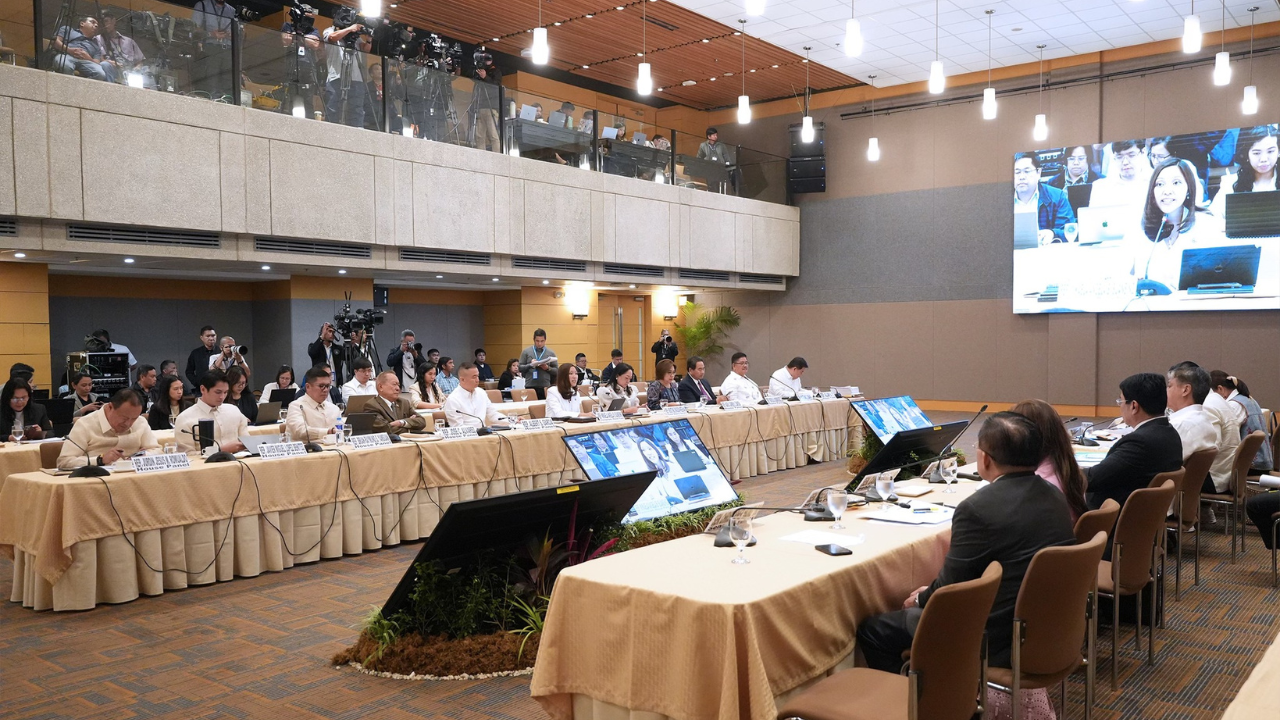
The bicameral conference committee reconciling the Senate and House versions of the proposed 2026 national budget has restored the allocation for the Office of the Vice President (OVP) to P889 million, reverting to the amount originally proposed by Malacañang in the National Expenditure Program (NEP).
The decision was reached during a committee meeting that extended late into Tuesday night, as lawmakers worked to resolve differences between the two chambers’ versions of the General Appropriations Bill (GAB). Nueva Ecija Rep.
Mikaela Suansing, chair of the House committee on appropriations, said the House version of the budget had set the OVP’s allocation at P733.1 million, roughly the same amount granted to the office for the current year.
Senate finance committee chair Sen. Sherwin Gatchalian, however, said the Senate version proposed a higher allocation of P889.2 million, reflecting the figure submitted by the executive branch at the start of the budget process. The bicameral conference committee eventually adopted the Senate-backed amount.
The OVP budget for 2026 had been the subject of prolonged deliberations, particularly in the House of Representatives, where several lawmakers sought to reduce the allocation after Vice President Sara Duterte failed to attend two scheduled hearings on her office’s proposed budget.
Duterte later appeared at the House hearing on Sept. 16 after being given another opportunity.
Following her appearance, members of both the majority and minority blocs observed parliamentary tradition by refraining from questioning the Vice President on the proposed budget during the committee-level discussions.
However, Duterte did not attend the subsequent plenary deliberations in the House, prompting lawmakers to simply adopt the OVP’s 2025 budget level for the chamber’s version of the 2026 GAB.
Aside from the OVP allocation, the bicameral conference committee also approved increases in the budgets of other key government offices.
The budget for the Office of the President was raised to P28.02 billion, up from the P27.28 billion allocation approved in the House version of the GAB. Funding for Congress was likewise increased, with the combined budget of both chambers rising to P38.6 billion from P37.19 billion.
Under the approved breakdown, the House of Representatives will receive P27.7 billion, the Senate P8.57 billion, the Commission on Appointments P1.68 billion, the Senate Electoral Tribunal P390 million, and the House of Representatives Electoral Tribunal P256 million.
The bicameral panel also made progress in resolving a budget deadlock involving the Department of Public Works and Highways (DPWH), whose funding had earlier stalled discussions after the Senate slashed P45 billion from its proposed 2026 budget.
DPWH Secretary Vince Dizon had appealed for the restoration of the cut, arguing that the reduction would affect the implementability of infrastructure projects.
On Wednesday, Gatchalian said a portion of the P45 billion reduction may be reinstated, although he clarified that the full amount would not be restored.
He said the revised figure would be lower after adjustments were made to account for logistical considerations and more realistic cost estimates.
“It will be less because they factored in logistics, hauling, indirect costs, and other expenses to make it realistic … the DPWH is arguing that their budget is not implementable because the numbers given to us were too general,” Gatchalian said.
Dizon had earlier pushed for the reinstatement of the P45 billion cut, citing updates to the Construction Materials Price Data (CMPD), which the DPWH uses as a basis for planning and costing infrastructure projects.
On Tuesday, the DPWH issued an apology “for the insufficient initial data [it] submitted to the Senate committee on finance regarding the application of CMPD.”
The department also sent a letter to Gatchalian providing additional data broken down by project category. The submission incorporated variables such as hauling distances and localized market behavior, which the DPWH said would result in a more accurate and realistic basis for funding.
As budget deliberations continued, lawmakers from both chambers expressed hope that the bicameral conference committee could conclude its work on the proposed 2026 national budget by Wednesday night.
As of this writing, the budgets of 11 government agencies remained unresolved, with the DPWH allocation still considered the most contentious issue.
Other agencies whose budgets were still scheduled for deliberation included the Departments of Tourism and Trade, the judiciary, the Civil Service Commission, the Commission on Audit, the Commission on Elections, the Office of the Ombudsman, government-owned and -controlled corporations, special purpose funds, the military modernization program, and the controversial unprogrammed appropriations.
Suansing said both chambers were optimistic about completing the bicameral process by Dec. 17. “Based on our latest count with Sen. Win, we still have 11 to go. But we’re very, very positive that we’ll be able to finish the bicam,” she said.
“We will do our best. Of course, the teams—both from the House and the Senate—will also work overtime. Even during the holidays, even on Christmas. While others will be celebrating Christmas, we will be working through Christmas.”